Freitag, 22. Juni 2012

Santa Maria


We were early this year to head for the Azores, 7 weeks earlier than last year. On the other hand, early June is the time when the first boats return from the very popular Atlantic circle to the Caribbean and back. It is said that about 1000 yachts come via this route through the Azores every year. That, however doesn't change the fact, that the weather isn't really settled in the islands at this time, and rain and westerlies are still prevailing. The reason why the bulk of the boats comes in that early in the season, is that in the Caribbean that Hurricane season starts and it is usually time to leave there in mid May.

For us, cruising this side of the Atlantic, it is wiser to stay south in the Canaries or the Cape Verdes before heading for the Azores in late July. But this year we singed up for the Rally Bayona, which starts in early August and thus we need to leave the Azores in late July.

It is also easier to sail the Azores from west to east, and that is why last year we sailed straight to Flores, the westernmost island. Now in early June, this wasn't so easy, as the lows are still tracking at fairly low latitude and it would be head winds most of the way.

Even sailing to Santa Maria, at the south-eastern end of the Azores, required us to sail first westwards for two days until the north easterly winds die, and the almost straight north, close hauled westerly winds. While the direct distance fromLa Palma to Santa Maria is 620 miles, we had to sail 710 miles, which isn't so bad given the conditions. It took us four and a half days and we arrived in the well known marina after dark, on June 7.

We went straight to a berth that we had been in before, and were quite astonished to see the harbor master that late in the night taking our lines and telling us at the same time that we will have to move the morning to a smaller berth further in, as he was expecting part of the ARC-Europe fleet with several bigger boats.

Next morning we moved with fairly strong wind blowing in to the marina, which is never ideal for maneuvering, but with our bow-thruster we thought we should be fine in the narrow confines of the marina further in. The surprise came when we tried to turn into the berth we had picked. Just at that moment our bow-thruster decided to not work towards starboard, the direction we needed to bring the bow into the wind. We quickly turned the other way and picked another berth and managed to get in without any serious problems. Thanks to the deck crew, who had set up docking lines on both sides, just in case. The electrical problem was then solved in 10 minutes, a corroded contact in the steering column.

In the third picture you can see Taniwani as the left-most boat, all the way in on the middle pontoon. It was actually a nice spot, much quieter then all the way out towards the fishing dock, where the big tuna boats keep running their generators all need to circulate the bait tanks. The down side however was rather poor WiFi reception.

THe ARC-fllet had joined a local regatta, down from Ponta Delgada on Sao Miguel and it finally was just 8 ARC boats and 4 local boats. Still, the little marina was fuller than we ever saw it before and the little Village of Port Vila arranged various performances for the entertainment of their visitors. See for example the drummers in the second picture. The gang left after a day and Port Vila was back to its usual tranquil life style. And we eventually moved out again, to get a better WiFi connection.

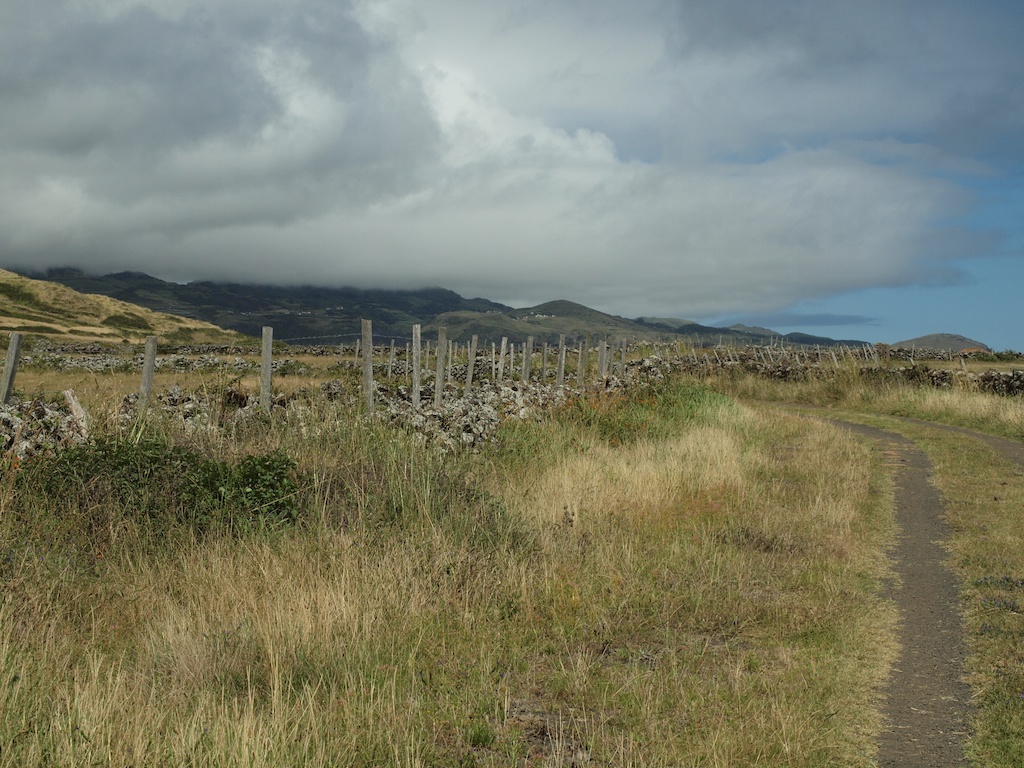
As always we took a car for a day and toured the little island. It is easy to see about every corner during a day, driving less than a hundred kilometers. But it is always a nice tour and the advantage of being early in the year, is that the island is still lush green and the waterfall in the east still has some water purring down the narrow chimney it had cut in thousands of years. Santa Maria is a lot drier and warmer than Flores on the other end of the chain, some 300 miles to the Northwest.

We drove by the little hospital that helped Harald last year, but chose to skip it this year. We definitely avoided swimming in the bay, but it seems that the sewer problem, that caused Harald's prostate infection, might soon be under control: The eastern part of the village, that seeming drained some sewage into the river is now is now getting a new sewer system. See picture 5 for that.

We spent about a week in Santa Maria, waiting for favorable winds to go westwards, but they didn't appear. When it seemed we would be better of further north, we moved on to Ponta Delgada on the big island of Sao Miguel. Ponta Delgada as such is not our favorite, but the excellent market there is definitely worth a short stop. That's not saying that the island isn't nice, rather the opposite. Sao Miguel has a lot to offer and it takes a few days by car to just see the best places. We had driven around on Sao Miguel a few times before and just thought we skip this part this time around.

We left Ponta Delgada bound for Velas on Sao Jorge on Sunday, June 17. More about Sao Jorge in the next episode.






Samstag, 2. Juni 2012

La Palma


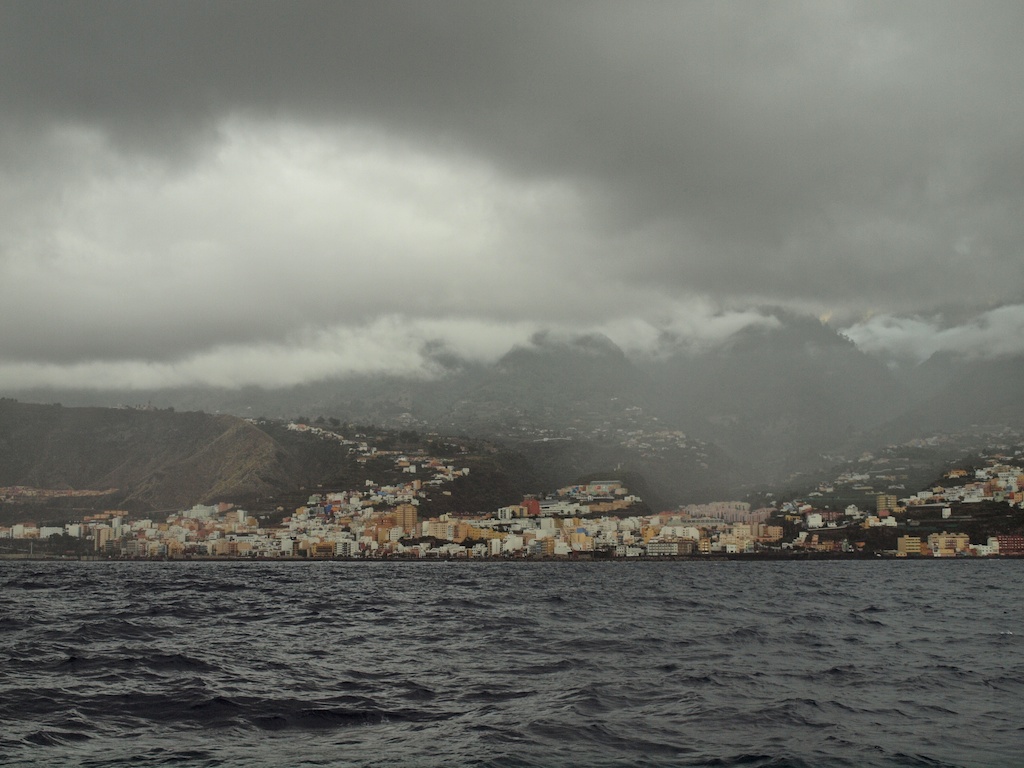
Here are just a few impressions from La Palma, which we confirmed to be our favorite Canraian island.  This time we had a rental car for three days and toured the island extensively. As always, impressively beautiful. It is hard to tell wether it is the clear height at 2000m with their impressive views, the laurel forests at the wetter Northeast, the rather distinct fir trees in the central caldeira, or maybe the fairly young volcanos in the south.

Together with just light tourism and the friendly capital of Santa Cruz, it  all adds up to a wonderful impression.

For us a week went by in no time. Now we plan to finally take off for the Azores. While the summer weather, with the typical Azores High hasn't yet settled in, so that we will have to deal with westerly winds once north of Madeira's latitude, we thought we will aim for Flores to make some distance towards west, and after two days turn north to Sanat Maria.

This means we will sail trough the Azores East to West and then West to East again, before taking off for the mainland in late July. - At least, that's the plan…...


Sonntag, 27. Mai 2012

Selvagens to La Palma


It was getting dark when we arrived back at Selvagem Grande and for a moment we considered just to drop off our friends and leave right away. While the swell seemed bigger than in the previous night and it was definitely not comfortable, but as safe as it gets there, we finally gave in to another night at anchor.

In the morning conditions improved with more wind and less swell and around 11 we weighed anchor, said good-by to our friends via radio, and set off to La Palma.

Sailing was mostly smooth and comfortable, with wind and waves nearly from behind. Not fast but ok. 

Next morning we arrived at La Plama which had piled up some clouds and from sunshine at sea we went into a light drizzle as we entered the harbor and marina.

With lots of space in the marina, we were given free choice on where to moor Taniwani and we decided to go into one of the bigger berths at the innermost wall. Then it was time to relax and for a night with undisturbed sleep.

Today, Sunday, we just had a short walk through the town, with all shops closed. Tomorrow we will get a car and explore the island for three days, before moving Taniwani around the island to the west side to Tazacorte.

Stay tuned for more on La Plama…..


Selvagem Pequena

Next morning, after a reasonably quiet night at the exposed anchorage, we picked up Frank and Buffy for a day trip to the even remoter and much smaller island of Selvagem Pequena. While the wind was still light, the big ocean swell seemed to have picked up and the breakers over the reefs looked frightening. While at Grande the dinghy landing is quite sheltered with a good concrete ramp, landing on Pequena is a completely different story. Luckily we had the experts with us, who told us that the only spot to land a dinghy is far from the only spot where you can reasonably safely anchor a yacht. One of the pictures shows the breakers inside of Taniwani anchorage and it is quite obvious what would happen, should you attempt to land anywhere near the eastern end of the island.

Guided by our experts, we had a wild dinghy ride of at least one mile, around rocks and reefs, surfing on serious surge, all the way to the western end of the little island. There one finds a little sand beach, divided in half by a big rock. The right half of the beach is also the 'official' landing place of the park wardens who keep their little boat there and from there a short path leads to their tiny house.

The two wardens, who had just started their three week turn, quickly came to the beach and helped us bringing the dinghy ashore.

Pequena is even remoter and even more authentic and unspoiled, with a number of plants only known to grow on that island. After, unfortunately not successful, trying to make the pay TV box in warden hut work, we started for an extensive guided tour of the little island. We climbed its peak with light at 49m and then strolled along the beach line all the way back to the landing place. A fantastic and extremely interesting tour. A really mystical place.

We took off just in time to not arrive in darkness at Selvagem Grande which is 10 miles to the Northeast from Pequena.


Funchal - Selvagem Grande

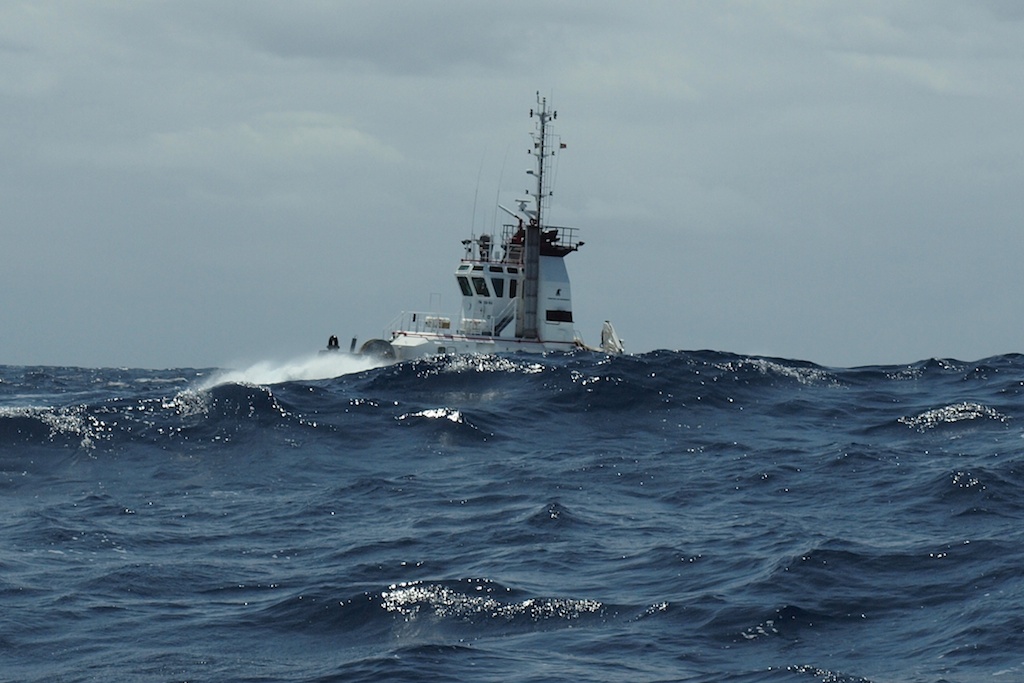
After five relaxing days anchored in Porto Santo, we chose to have a Sunday sail to Funchal before turning south. It turned out a swift and comfortable ride, despite a huge swell running from Northeast. The picture of the Madeira harbor tug "Ponta do Pargo" who we met between the islands gives a vague idea of the sea state.

In Funchal we were asked to tie up alongside oft the traditional park supply boat "Buteo". For Funchal a quite good place and much more convenient than on the rough harbor wall, especially so if you consider that we had spring tides of up to 3m. Despite the more and more worn down and overcrowded marina, Funchal as such is always a must for us and one of the very special places to be with your boat.

We only planned to stay for two nights, as we had already made appointments on the Selvagens: Our friends Dr. Frank Zino and his wife Buffy were on their way to the islands by means of the Navy ship and decreasing and light winds were forecast for the next days, so that it seemed wise to not wait much longer. 

When we left Funchal on Tuesday (May 22) that wind had indeed decreased and continued to do so. Unfortunately the swell continued driven from windier areas further away. This is not good for sail boats, as light winds alone may be ok with enough sail and some patience, but big seas along with it shake the boat and knock the sails around, especially with wind from the aft quarter. For us the solution was to let the engine run in addition at very low revs. 

Having been to the Selvagens twice before, we know that it isn't practical to visit there in all sorts of weather conditions. All anchorages are open to the south and the west and holding isn't good enough to allow any significant changes in direction as the anchor will have to hook up to something rocky.

While a bit slow, we still arrived around noon next day, well in time for a dinner at sunset. In the evening, the entire human population on Selvagem Grande, (6 including us), gathered on the spectacular terrace of the Zino estate, which is a little higher up and with an even better view than the ranger station, the only other house on the island.

The first picture shows the view from the terrace after sunset, with Taniwani anchored in the Ensenada das Cagarras, the next five of us: From left to right: Dr. Frank Zino, park warden Jacques da Mata, Carolina Santos from Park National Madeira and in charge of the Selvagens, Buffy our host and excellent cook, and Beate one half of the Taniwani crew.

We were still early in the season and the Cagarra population hasn't fully arrived at the islands for breeding. But a black tern found his way onto our dinner place and landed, slightly confused by the bright gas light, next to our dinner table.
Frank expertly picked up the bird and gave it the small scientific treat, which included weighing and ringing, but no blood samples for DNA this time.

Frank, who since his youth had regularly spent much time on these remote islands, had many interesting stories for us and so we only returned to Taniwani close to midnight.


Freitag, 18. Mai 2012

Porto Santo again

Finally the cruising has started and last Tuesday we left the marina at Quinta do Lorde and headed for the neighbor island of Porto Santo. Already at the eastern end of Madeira it was only a short 30+ mile passage. While normally, at least in the summer months, the wind blows strong from NE, which would be fully on the nose, we had the nice exception of a moderate NW allowing us to beam reach comfortably and swift to Porto Santo where we anchored near the harbor, off the 3 mile long sand beach. 

With the winds around North we have now been happily anchored here for three days and plan to enjoy another day before sailing back to Madeira, this time just for a short last visit in Funchal. We expect a similar if a bit longer passage back.

Here in Porto Santo, we drive the dinghy up the shore on its wheels and are this way quite close to the largest super market, which would otherwise be a two kilometer walk from the harbor. There doesn't seem to be any public transport on Porto Santo, so the tender comes in quite convenient. In calm conditions there is no advantage going into the harbor and the small marina which doesn't have much space for boats of our size anyway.

It is a rather sleepy place here and the ferry from Madeira has thinned out its schedule compared to last year. For us cruisers this is off course all fine and we enjoy the island thoroughly.

As always a few picture. By the way, if you click on them you get them in bigger size and you can page through the set that goes with one blog entry.

Next report will probably be sent from somewhere on the Canaries, but let's see…..


Montag, 14. Mai 2012

Madeira Again

Yes, we are back to Madeira and have just launched TANIWANI again. Wintering beneath the giant runway was good, with less than usual UV and no rain. Just a thin film of kerosine has covered mast and rig, almost as if you had sprayed it with WD-40. Certainly fine to prevent corrosion, but maybe not so nice for putting sails on. So, there was a bit of cleaning of the head foils necessary. The folks at Repmarine, the little yard under the runway, had done a nice job, applying fresh anti-fouling and polishing the whole boat.

Last Wednesday, May 8, TANIWANI was carefully maneuvered back into the water by the skilled travel-lift operator from Madeira's Sea Rescue. With just the main ready in case of an unlikely engine failure, we moved only some three miles to the nice marina Quinta do Lorde, where we worked a few days to get the boat entirely ready for some months of ocean cruising.

Now we are ready, to leave the marina and will probably first sail over to the neighbor island of Porto Santo for a few days at the lovely beach there. Later we hope to go on to the Azores, possibly via La Palma. And in August we are expected in Galicia. All else depends on the wind, so stay tuned to see where we may drift…

This time just one picture showing TANIWANI#s winter home, with TANIWANI just left of the big pillar in the middle.